 Clan Crawford Association
History of Southern Scotland

55 B.C.-1066 A.D
Roman Occupation of England and Southern Scotland
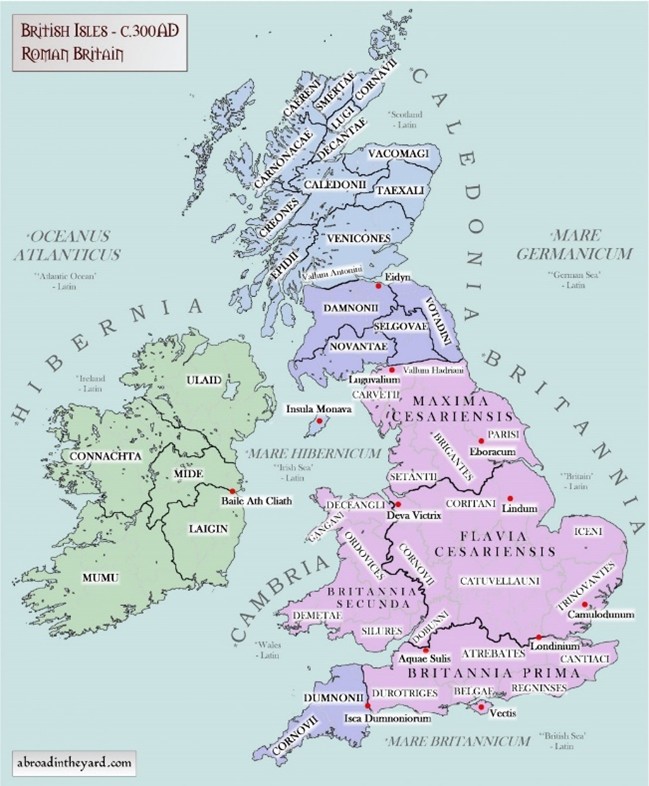
The Romans encountered various Britannic Celtic tribes in Britain. A map of these tribes is provided to help the reader trace the movements of the Romans as they encountered these tribes.Figure 2. British Isles Circa 300 A.D. The conquered area in pink was held permanently. The area in purple south of the Firth of Fourth was occupied and then fluctuated in influence and was contained by Hadrian’s wall on the south and Agricola’s wall on the north and stopped at the highland shown in blue. Ireland in Green was never attacked by the Romans
Julius Caesar First Invades Britain
The following summary of Roman occupation of Britain is taken from (Tacitus, 98 A.D.) and Julius Caesars “Commentaries on the Gallic War”. Julius Caesar led an invasion of Britain in two campaigns, one in 55 B.C, and the other in 54 B.C. These were short lived and penetrated only a short distance into Britain. Caesar was forced to leave when a storm damaged his fleet and made it dangerous to remain.
Emperor Claudius and Aulus Plautius Conquer Most of England
In 43 A.D., the Emperor Claudius sent Aulus Plautius to Britain who conquered all Southeast Britain and the Isle of Wight without trouble. Later Claudius personally led these expeditions. By 49 A.D. the Romans had conquered Lincoln, Wroxeter, and Chester.
By 74 A.D. the Romans had defeated the Brigantes in Yorkshire and in 77 A.D the Silures in South Wales were defeated. In 77 A.D. Gnaeus Julius Agricola was appointed Governor of Britain and began seven campaigns.
- In 77 A.D. he defeated the Ordovices in Anglesay and stationed the 20th Legion in Chester.
- In 78 A.D. Agricola advanced to the North and garrisons were placed between Solway Firth and Tyne.
- In 79 A.D. his army advanced to the Tweed or Tyne Rivers in southern Scotland.
- Agricola battled north in 80 A.D. as far as the Clyde River and the Firth of Forth. And established forts between them. It may have been at this time that the Roman fort was built on the Clyde River in the village of Crawford.
- In 81 A.D. the army moved up the west coast to Solway Firth and Dumfries. Posts were established along the coast facing Ireland.
- In 82 A.D. Agricola advanced into Caledonia and Agricola’s fleet reached Fife. The Caledonians attacked forts west of Tay and tried to storm the camp of the ninth legion. Agricola established additional forts at Ardoch, and Inchtuthil.
- In 83 A.D. Agricola and the Caledonians were engaged in a great battle at Mons Grampius in Perthshire. The Romans claimed victory but there was no further penetration into the Highlands.
In 84 A.D. Agricola was recalled to Rome. Thereafter, the Romans tried to retain what they had gained but the Caledonians continued to attack the Roman garrisons. Under Emperor Hadrian, a great wall was built from Newcastle to Carlisle and Antonius Pius added his wall from Clyde to the Forth in along the line of Agricola’s forts in 142 A.D. and it was referred to as the Antonine Wall and abandoned in 162 A.D..
In 209, Septimus Severus led his Roman army north into the highlands and roughly marched the same way Agricola had invaded over 100 years before. Severus suffered heavy casualties due to the guerrilla tactics used by the Caledonians.[4] Because of this Severus began a plan of holding down all the territory he could by the reoccupation of many of Agricola’s old forts and devastating all the territory he couldn’t. This led to many of the tribes attempting to reach a peace agreement with Severus because of fear of extinction through Roman genocide. Peace talks failed and it looked as if the war would continue until all the tribes had submitted to Rome or been exterminated.[5]
In early 210 Severus’ son Caracalla led a punitive expedition north of the Antonine wall with the intention of killing everyone he came across and looting and burning everything of value. The plan was for Severus to follow his son’s army and permanently occupy all of Caledonia. In 210, Severus became ill and went to York to rest and recover. He kept getting worse until 4 February 211 when he died.
Caracalla then called off the war against the Caledonians and headed back to Rome to consolidate his power. Although forts erected by the Roman army of the Severan campaign were placed near those established by Agricola and were clustered at the mouths of the glens in the Highlands, the Caledonians were again in revolt in 210–211 and these were overrun. The Romans never campaigned deep into Caledonia again because they lacked spare forces to continue dealing with attacks as most manpower was redirected to secure other occupied lands. They soon withdrew south permanently to Hadrian’s Wall.
The end of Roman rule occurred quickly in 407 A.D. when the Roman Legions were called home to Rome to address the attacks of the Goths against Rome. Virtually overnight the presence and protection of Rome was removed after 300 years. The enslaved peoples of Britain and southern Scotland were free to do whatever they desired
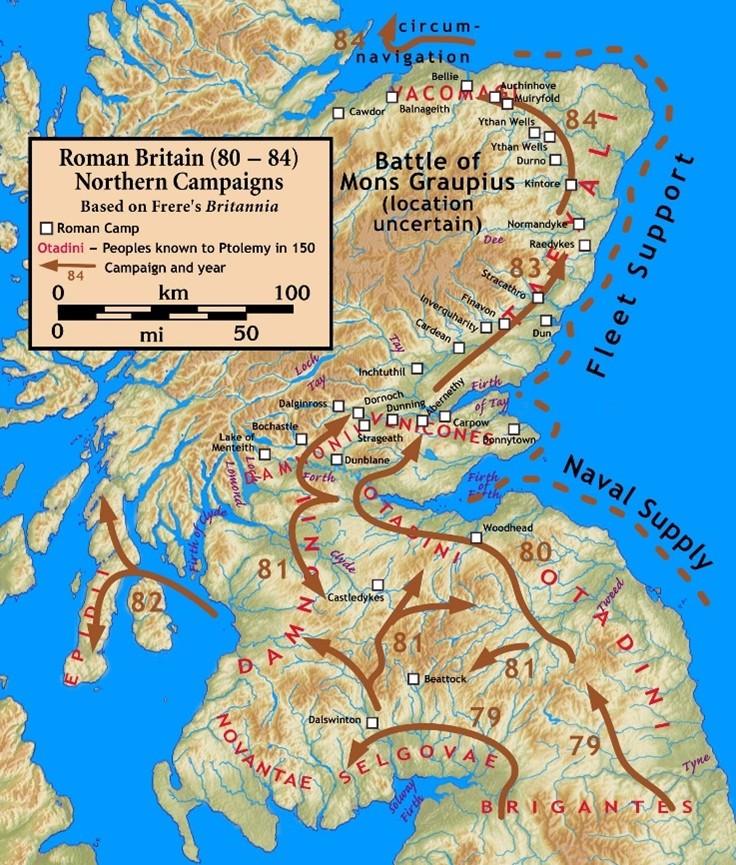
Figure 2. Conquest of Scotland by the Roman General Agricola
Boudicca Rebellion Against the Romans
Celtic women were active in fighting the Roman invaders as well as Celtic men. In 43 AD, before the time that Boudicca reached adulthood, the Romans invaded Britain, and most of the Celtic tribes were forced to submit. However, the Romans allowed two Celtic kings of the Iceni Tribe to retain some of their traditional power as it was normal Roman practice to allow kingdoms their independence for the lifetime of their current king, who would then agree to leave his kingdom to Rome in his will.
One of these kings was Prasutagus, whom Boudicca married at the age of 18. Together they had two daughters, called Isolda and Siora. However, it was not a time of harmony for Boudicca and Prasutagus.
The Roman occupation brought increased settlement, military presence and attempts to suppress Celtic religious culture. There were major economic changes, including heavy taxes.
In 60 AD life changed dramatically for Boudicca, with the death of her husband. As Prasutagus had ruled as a nominally independent, but forced ‘ally’ of Rome, he left his kingdom jointly to his wife and daughters and to the Roman emperor. However, Roman law only allowed inheritance through the male line, so when Prasutagus died, his attempts to preserve his line were ignored and his kingdom was annexed as if it had been conquered.
To humiliate the former rulers, the Romans confiscated Prasutagus’s land and property, took the nobles as slaves, publicly flogged Boudicca, and raped their two daughters. This would prove to be the catalyst which would see Boudicca demanding revenge against the brutal invaders of her lands.
And so Boudicca began her campaign to summon the Britons to fight against the Romans. While the provincial Roman governor Suetonius Paulinus was absent in 60 or 61 AD, Boudicca raised a rebellion throughout East Anglia. The insurgents burned Camulodunum (Colchester), Verulamium (St. Albans), the mart of Londinium (London), and several military posts. According to Tacitus, Boudicca’s rebels massacred 70,000 Romans and pro-Roman Britons and cut to pieces the Roman 9th Legion. Paulinus met the Britons at a point thought to be near present-day Fenny Stratford and regained the province in a desperate battle. Upon her loss, Boudicca either took poison or died of shock or illness.
Agricola's Northern Campaign
By 74 A.D. the Romans had defeated the Brigantes in Yorkshire and in 77 A.D the Silures in South Wales were defeated. In 77 A.D. Gnaeus Julius Agricola was appointed Governor of Britain and began seven campaigns.
- In 77 A.D. he defeated the Ordovices in Anglesay and stationed the 20th Legion in Chester.
- In 78 A.D. Agricola advanced to the North and garrisons were placed between Solway Firth and Tyne.
- In 79 A.D. his army advanced to the Tweed or Tyne Rivers in southern Scotland.
- Agricola battled north in 80 A.D. as far as the Clyde River and the Firth of Forth. And established forts between them. It may have been at this time that the Roman fort was built on the Clyde River in the village of Crawford.
- In 81 A.D. the army moved up the west coast to Solway Firth and Dumfries. Posts were established along the coast facing Ireland.
- In 82 A.D. Agricola advanced into Caledonia and Agricola’s fleet reached Fife. The Caledonians attacked forts west of Tay and tried to storm the camp of the ninth legion. Agricola established additional forts at Ardoch, and Inchtuthil.
- In 83 A.D. Agricola and the Caledonians were engaged in a great battle at Mons Grampius in Perthshire. The Romans claimed victory but there was no further penetration into the Highlands.
In 84 A.D. Agricola was recalled to Rome. Thereafter, the Romans tried to retain what they had gained but the Caledonians continued to attack the Roman garrisons. Under Emperor Hadrian, a great wall was built from Newcastle to Carlisle and Antonius Pius added his wall from Clyde to the Forth along the line of Agricola’s forts.
In 209, Septimus Severus led his Roman army north into the highlands and roughly marched the same way Agricola had invaded over 100 years before. Severus suffered heavy casualties due to the guerrilla tactics used by the Caledonians.[4] Because of this Severus began a plan of holding down all the territory he could by the reoccupation of many of Agricola’s old forts and devastating all the territory he couldn’t. This led to many of the tribes attempting to reach a peace agreement with Severus because of fear of extinction through Roman genocide. Peace talks failed and it looked as if the war would continue until all the tribes had submitted to Rome or been exterminated.[5]
In early 210 Severus’ son Caracalla led a punitive expedition north of the Antonine wall with the intention of killing everyone he came across and looting and burning everything of value. The plan was for Severus to follow his son’s army and permanently occupy all of Caledonia. In 210, Severus became ill and went to York to rest and recover. He kept getting worse until 4 February 211 when he died.
Caracalla then called off the war against the Caledonians and headed back to Rome to consolidate his power. Although forts erected by the Roman army of the Severan campaign were placed near those established by Agricola and were clustered at the mouths of the glens in the Highlands, the Caledonians were again in revolt in 210–211 and these were overrun.[6]The Romans never campaigned deep into Caledonia again because they lacked spare forces to continue dealing with attacks as most manpower was redirected to secure other occupied lands.[7] They soon withdrew south permanently to Hadrian’s Wall.
The end of Roman rule occurred quickly in 407 A.D. when the Roman Legions were called home to Rome to address the attacks of the Goths against Rome. Virtually overnight the presence and protection of Rome was removed after 300 years. The enslaved peoples of Britain and southern Scotland were free to do whatever they desired
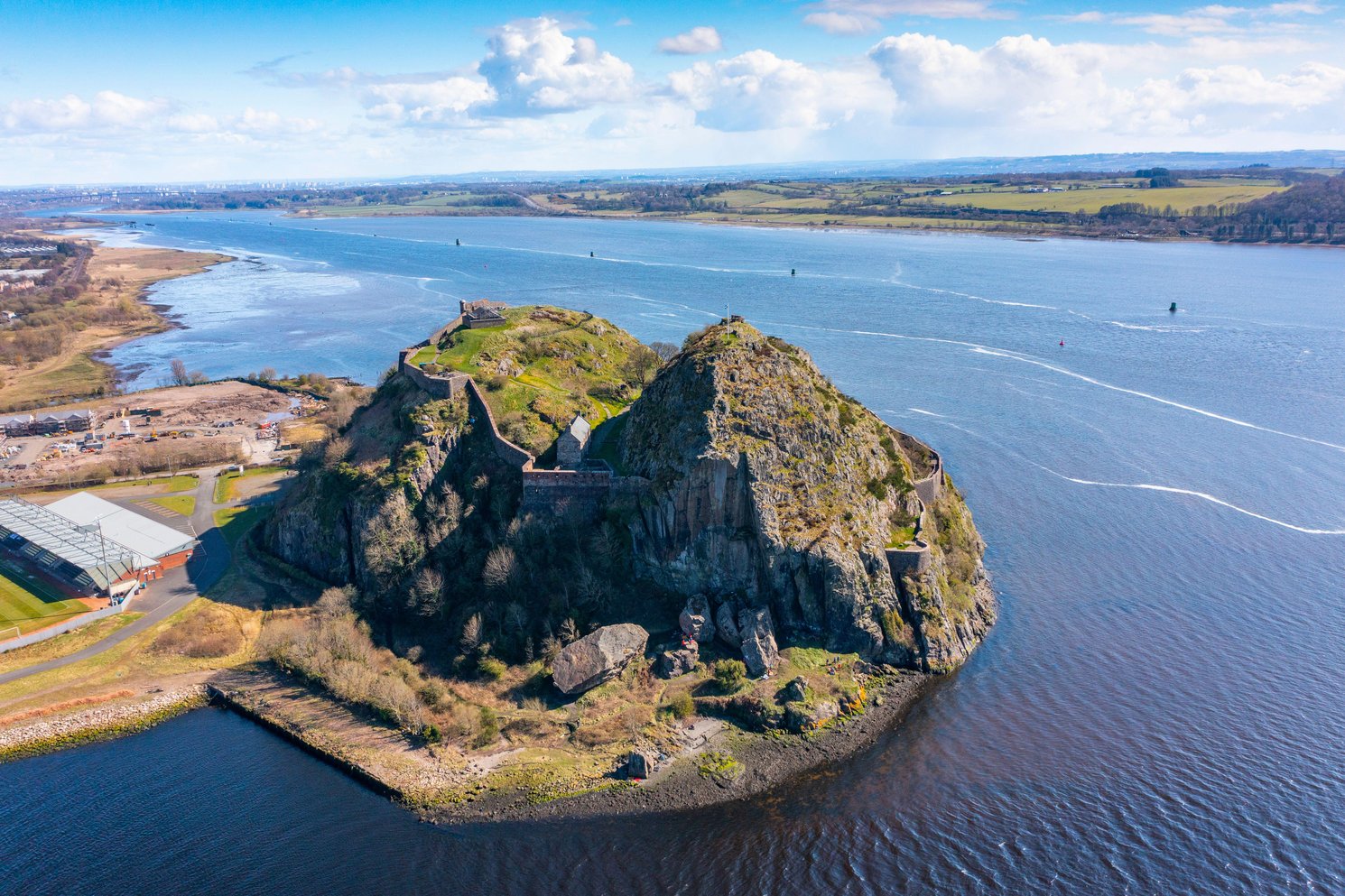
The Damnonii and Strathclyde
https://www.historyfiles.co.uk/KingListsBritain/BritainStrathclyde.htm#AltClut
The British Damnonii tribe which included the area where the Barony of Crawford existed apparently created a kingdom in what is now south-western Scotland even before Roman control of the country had ended at the start of the fifth century AD. According to the few reliable records available, it was certainly firmly established by the late fifth century under the name of Alt Clut, one of the kingdoms controlled as part of ‘The Old North’ or, in Brythonic, Henn Ogledd.
The area lay between Hadrians Wall and Agrippa’s line of forts to the north known as the Antonine wall. However, it was forever outside the Roman province of Britannia Secunda, which later became the ‘Kingdom of Northern Britain’, and therefore not part of the subsequent break-up process which so weakened that territory.
The kingdom maintained a virtually impregnable capital at Dumbarton Rock, which overlooks the estuary of the Clyde. Its forces continually shrugged off attacks by Picts and Northumbrians, but the Vikings proved a tougher opponent. In 870-871, after a four-month siege, they managed to penetrate its defenses, and the Celtic kingdom fell to them. The ambitious Scotti, long-term rivals of the Picts in northern Scotland, ensured that the last Brythonic king of Alt Clut, Arthgal, was executed by the Vikings. Once the Vikings had finished wintering there, this act secured the kingdom for Rhun, brother-in-law of Constantine I of the Scotti but also son of Arthgal himself.
The Scotti knew the kingdom as Strathclyde, all of which meant ‘straddling’ or ‘crossing the Clyde’. The old Brythonic P Gaelic name of Alt Clut appears to have been dropped very quickly by the Q Gaelic-speaking Scots, probably because the kingdom’s focus now moved away from the rock to a safer location in the valley of the Clyde. Once King Rhun had seized the throne, it was regarded as a junior territory of Scotland itself, although direct control by the Scots may have been transitory and far from usual.
Strathclyde apparently managed to extend the area under its control into Cumbria from about AD 900 onwards, but there are two schools of thought about this. One is that Scottish/Strathclyde sub-kings did indeed manage to extend their area of influence southwards into former Rheged, which had been conquered by the Northumbrian Angles and then taken over by various Viking elements, possibly with support from York. The other is that the shadowy ‘kings of Cumbria’ (Cumbria being a purely Brythonic name which is related to the Welsh ‘(cymri’) managed to reassert independent control of the region following the removal of Anglian and Viking authority. Numerous place names which point to a Brythonic origin confirm that a strong native element was still holding onto some form of control, but were they truly independent or merely elements of an expanded Strathclyde? If the former, then this was the last independent Brythonic kingdom to exist outside of Wales itself.
The Y-DNA of the males in Strathclyde would have been R1b-21 found in all of the Celtic populations in Britain prior to invasions by the Romans, Anglo-Saxons, Danes, Vikings, and western European populations such as the Normans, Flemish, and Belgium. Since the Crawford surname Project contains 200 males in over 30 lineages of R1b-21, our Celtic roots would have come from the Damnonii as well as the Picts and Dalriata and the name Crawford may have been used by the Damnonii when fighting the Romans at the Ford over the Clyde in 500 A.D.
(Information by Peter Kessler, with additional information by Mick Baker, from Kings and Warriors, Craftsmen and Priests in Northern Britain AD 550-850, Leslie Alcock (Society of Antiquaries of Scotland, Edinburgh, 2003), from The Kingship of the Scots 842-1292: Succession and Independence, A A M Duncan (Edinburgh University Press, Edinburgh, 2002)
Warlords and Holy Men: Scotland AD 80-1000, Alfred P Smyth (1984), from Anglo-Saxon England, Frank Stenton (Third Ed, Oxford University Press, 1971)
The Men of the North: The Britons and Southern Scotland, Tim Clarkson (EPUB, 2010), from The Makers of Scotland: Picts, Romans, Gaels and Vikings, Tim Clarkson (EPUB, 2012),
The Picts: A History, Tim Clarkson (2012, EPUB), from Strathclyde and the Anglo-Saxons in the Viking Age, Tim Clarkson (EPUB, 2014)
External Links: Duncan I [Donnchad ua Maíl Choluim], D Broun (Oxford Dictionary of National Biography), and Libellus de exordio atque procurso istius, hoc est Dunhelmensis, ecclesie (Tract on the origins and progress of this the church of Durham), Symeon of Durham (Rev
The capital was the Rock of the Clyde known as Dunbarton Rock. The people were Britons who spoke a Cumbric Gadoleic Gaelic closely related to old Welsh which was somewhat different than the Irish and Pictish Gaelic to the North. They were closely akin to the Celtic residents of Wales and Cornwall.
The kingdom suffered a terrible setback when the Vikings in 870 AD besieged Dunbarton Rock for four months. They destroyed the fort and took the king hostage.
After Dunbarton tragedy they moved the kingdom capital to Govan which is modern day Glasgow. Strathclyde was eventually absorbed into the growing kingdom of Alba which probably occurred after the battle of Carham in 1018.
Strathclyde has often been linked to the tales of King Arthur and the origins of Merlin. The famous battle of Artherdet (573) which involved the kings of Strathclyde has been cited by some authors as the event that inspired the Arthurian myths
Angles, Saxons and Jutes (449-1066 A.D.)
The following summary is taken from (Hall, et al., 1946).
According to legend, in the year 449, Britain invited the Angles, Saxons, and Jutes under their leaders Hengist and Horsa to come to Britain and help them defend against the Picts from the North and the Irish Dalriata from the west. However, the newcomers overran the country and plundered all the local cities. The Druid priests were killed and the altars overturned. The people and the leaders were killed without any regard to person or position. These newcomers were from lower Scandinavia, and the northwest corner of Germany. The Angles came from southern Denmark and the Saxons lived along the Elbe River. The Jutes lived along the coast from the border of Sweden into central Denmark. All three tribes were closely akin in language, religion, customs and blood. This conquest continued for over two hundred years. It is not clear what happened to the Roman-Celtic inhabitants that were not killed outright. However, recent genetic information tends to indicate that the Celtic people are still present in the DNA of many locations in Britain. See (The Fine-scale Genetic Structure of the British Population, 2015)
In the next five centuries Christianity replaced the old Nordic gods of Woden, Freya, and Thor with a message of peace and love. Over the coming centuries the Roman Catholic church held sway over a vast area of Europe. This area was divided into provinces and each province was governed by an Archbishop. Each province was divided into dioceses, A bishop managed each diocese. In its turn each diocese was divided into parishes. The parish priest administered the sacraments, penance, marriage, as well as other duties. Archbishops, bishops, and priests were called secular clergy because they met the common people, in contrast to the regular clergy who were the cloistered nuns and monks. The church thus replaced the anarchy of the dark ages with multiple small feuding kingdoms that prevailed after the exodus of the Romans. Christianity brought a new way of living. From the cradle to the grave, it forced on the “Angleish” man a new law of conduct, new habits, new conceptions of life and society. It also stimulated schools of learning throughout the country. These changes led to a unified country called England. This happened slowly as the various kingdoms of England slowly melded into one.
The Danish Invasion and Conquest of England
The following timelines were taken from the Anglo-Saxon Chronicle (Unknown, 1000 to 1099) from the period 1000 to 1100 and are included as they seem to be related to links to Thorlongus, the Earls of Richmond, or the Flemish knights associated with the Crawfords. It can be viewed online at https://avalon.law.yale.edu/medieval/angsaxintro.asp.
In 1001 A.D., the Danish Vikings began invading England and spreading terror and devastation wherever they went. These Danes were of similar blood to the Saxons but lived further to the north. Their raids terrified the coastal communities of England. They plundered and burned the country. They proceeded westward as far as Devon and beyond.
The following year King Ethelred of England and the people of England decided to offer a tribute to the Danish fleet and to make peace with them if they would stop their raids. The tribute, known as the Danegeld, was 30,000 pounds in gold when it first began. However, beginning in 1004 and thereafter, King Sweyne and his Danish armies continued to attack England. In 1013 King Sweyne of Denmark conquered Northumbria, Lindsey, and came to London where all the thanes[1] submitted to Sweyne and he was considered full king of England. King Sweyne died in 1014.
Knute, son of King Sweyne, ruled over England after King Sweyne’s death. During this era many Danes settled in England, especially in Yorkshire and Northumberland.
In 1035 A.D. King Kanute died after reigning 20 years, and his body was interred in Winchester. Harold, son of Knute ruled 4 years and then died. In the same year, King Hardecanute, the son of Knute, was made king. He ruled 2 and a half years and died in 1042.
In 1043, the Anglo-Saxon, King Edward gained control. He married Earl Godwin’s daughter Edgitha in 1044. Earl Godwin had four sons, Earl Harold, Earl Sweyne, Earl Tosty and Grith. Earl Sweyne was causing trouble in the Kingdom and in 1047, Earl Sweyne went to Wales and then to Denmark. In 1048 he returned to England.
In 1049, Pope Leo of Rome and a huge army came against Baldwin of Bruges[2]. King Edward assisted the Pope by sending many ships near Sandwich so that Baldwin could not escape by sea. After the Pope’s settlement with Baldwin, which is not explained, King Edward gave leave to the Mercians to return home. While they were away Sweyne came back to England and murdered Earl Beorn. Then in 1051, King Edward and all his army proclaimed Earl Sweyne, an outlaw. Sweyne sailed to the land of Baldwin and stayed there all winter in Bruges. In 1050, Earl Sweyne had his sentence reversed by the bishop. Also, in 1050 King Edward abolished the Danegeld tribute, which King Ethelred had imposed.
In 1051, King Edward ordered Earl Godwin and his sons to appear at his court. In order not to go against King Edward and his army, Earl Godwin and his family moved south away from the King. In the morning when it was learned that they had left, King Edward held a council and proclaimed Earl Godwin and his family an outlaw. And Earl Godwin with his wife, Sweyne, Grith, Tosty and Tosty’s wife, who was a cousin of the Flemish Baldwin of Bruges (Belgium) sought Baldwin’s protection. They stayed in Bruges all winter. At the same time, Earl Harold went westward to Ireland and spent the winter under the Irish King’s protection.
At the end of 1051, the King and Earl Godwin made their peace in London and all that had been taken away from him and his family was restored. However, Earl Sweyne had left Bruges earlier and traveled to Jerusalem as a crusader but died on his way home in Constantinople, Turkey.
In 1053, while Earl Godwin and his sons Earl Harold and Tosty sat with King Edward at table, Earl Godwin suddenly sank below the table and could no longer speak. He continued in this condition for a few days and then died. He was buried in Winchester. Earl Harold, his oldest son, was given the earldom his father had and all that he possessed.
In 1065, Tosty had. become estranged from his brothers and sought the throne of England. Therefore, he had to leave England. Tosty and his wife and all who acted with him went south over the sea to Earl Baldwin[3], who received them all. They were there all winter.
In 1065, King Edward died on the eve of Twelfth Night Day and was buried. This year Earl Harold, son of Earl Godwin, was proclaimed King of England.
Meanwhile, in Scotland, Malcolm III (1058 A.D.-1093) of the House of Atholl, also known as Malcolm Ceann Mhor (the Big Head) had consolidated the Scots, subdued Strathclyde and added it to the Scottish throne.
[1] See the list of definitions at the beginning of this manuscript.
[2] Bruges This part of Belgium and Flanders is predominantly Flemish. Flemish is a Low Franconian dialect cluster of the Dutch language. It is sometimes referred to as Flemish Dutch, Belgian Dutch, or Southern Dutch. Flemish is native to the region known as Flanders in northern Belgium.
[3] As can be observed by these trips to Bruges the Baldwin nobles were well acquainted with the Godwin Earls and their families.
THE HISTORY OF SCOTLAND FROM 1058 UNTIL 1330 AND THE APPEARANCE OF THE SURNAME CRAWFORD
In this section you will find some names in bold who are important in tracing the pedigrees of the ancestors of the Crawfords.
Evidence for the existence of Thorlongus and his family
In the early part of 1066 the Norse King, Fair Haired Harold, and his ally Tosty attacked England with a large army. The Norse king was killed along with Tosty, who was seeking to overthrow his brother Harold. Many of the Normans and Flemish with Tosty were also killed in battle by King Harold (formerly Earl Harold) of England and his army.
In the meantime, Duke William of Normandy (the Conqueror) landed his fleet of Normans and Flemish knights[1] at Pevencey and proceeded to Hastings where a fortification was built. King Harold and his exhausted army then went to battle Duke William. During the subsequent battle King Harold of England and his brother Leofwine were killed and Duke William was proclaimed King of England and Normandy in the fall of 1066.
During the summer of 1067 the child Edgar, heir to King Harold’s throne, departed England, with his mother Agatha of Hungary, and his two sisters, Margaret and Christina, and Merle-Sweyne, and many good men with them; and they came to Scotland under the protection of King Malcolm, who entertained them all. Malcolm married Margaret from England. Margaret was the daughter of Edward Atheling. This began the large influence of the English court upon the Scottish throne and the beginning of the transition of southern Scotland into feudalism.
The Domesday Book of 1085 A.D.
King William of England commissioned a survey of all the lands of England in1085, detailing who held the lands and an inventory of the farms, buildings, livestock, houses, and the rents owed to the crown. This inventory twenty years after the Conquest demonstrated the changes in wealth and power and the full implementation of Feudalism. The ensuing report is known as the Domesday Book (Alecto Dommesday Editorial Board, 2002) and contains 1,436 pages. In over 90 percent of the properties held by free men discussed in Domesday, previous Anglo-Saxon and Danish owners were removed and Norman, Flemish, or Breton owners were given the land. By 1085 the king held everything under his control with the bishops gaining additional lands and people, and his knights and family members were provided with oversight of the remaining free holdings. All other individuals were either serfs or slaves bound to the land and required to pay rent to their overlords for parcels of land to farm. This method guaranteed that any uprisings could be quickly quelled. A survey of the Domesday Book for Yorkshire and some other shires did not reveal any previous landowners named Thorlongus. A full survey of the book was not done but the time frame is wrong for Thorlongus as well. The Domesday Book does reference a Baldwin and a Theobald briefly.
King William I, died in 1087 and his son William Rufus succeeded him from 1087 to 1100 and Henry I from 1100 to 1135.
Changes to the Scottish Throne
Over the coming years Malcolm III and Queen Margaret had six children. Edmund, Edgar, Alexander, and David as well as daughters Edith, and Mary. Edith was later called Matilda and married King Henry I of England. Mary, who became the mother of another Matilda, and that Matilda married Stephen, King of England.
So, from this there was a close relationship between the Scottish kings and the English kings. All the royal children would have known Merle Sweyne, and he was probably an uncle or second cousin. David was the youngest son having been born around 1083. When his father and mother died in 1093, David went to live with his sister Matilda, Queen of England at the age of 10 or 12. He would have seen first-hand how feudalism worked and would have met many Norman and Flemish knights. He would have known both King Rufus and King Henry and how they operated.
[1] The Flemish knights were mercenary soldiers of fortune.
The Norman Invasion and William the Conqueror
According to George Crawfurd (Crawfurd, 1793), “Thorlongus had two sons, Swane of Craufurd who had the lands of Crawfurd and William who became Sheriff of Stirling. Swane is then shown as the father of Hugh de Craufurd who has two daughters and Reginald the father of John of Craufurdjohn. This webpage is an effort to verify the above information and provide the written documents upon which we can rely as Clan Crawford. This has meant that most of the information available is contained in charters that were issued either by the kings of Scotland or by the bishops or abbots of the abbeys located in various parts of Scotland. Most of the information about Thorlongus and his family is found in (Lawrie, 1905), Volume 1 and 2 of the Regesta Regum Scottorum and the Liber S. Marie De Calchou volumes 1 and 2 of Kelso Abbey. Other information was derived from the charters of Newbattle Abbey as well.
We must always keep in mind that the histories available from the ninth through the eleventh centuries were produced by the elite of that era. Individuals who were kings, abbots, and bishops. Only the very few could read and write and those that could wrote almost exclusively in Latin. There may have been many individuals who referred to themselves as John or Mary of Crawford who were common farmers whose name would never appear in the written word.
The charters were recorded by clerks assigned by the king or abbot to formalize the events of that time. There were no spelling conventions then, and there are often variations in the spelling of the witnesses to the charters due to different clerks recording the events. You will encounter Sweyne, Swano, Swain. Swany, Suein, and Merleswano. It is evident that these versions are the same person. Also, there are numerous spellings of Thor in these charters but again they refer to the same person.
The charters found in the abbeys are very difficult to translate into English because the monks who recorded the charters used a Medieval form of Latin shorthand. Also, it is difficult to date the charters. This paper uses N.F. Shead (2007) https://scottishmedievalcharters.wordpress.com/links-for-scottish-medievalists/ to determine their dates of creation when the charter gives no date. The estimated dates of the charters of Kelso Abbey are also listed in Volume 1 of Liber S. Marie De Calchou in the Tabula.
You will find in the following pages new information about Thorlongus and his family and their places where they resided in Scotland.